
Trust Is Earned, Not Claimed: The Truth About Government Endorsements
Trust Is Earned, Not Claimed: The Truth About Government Endorsements
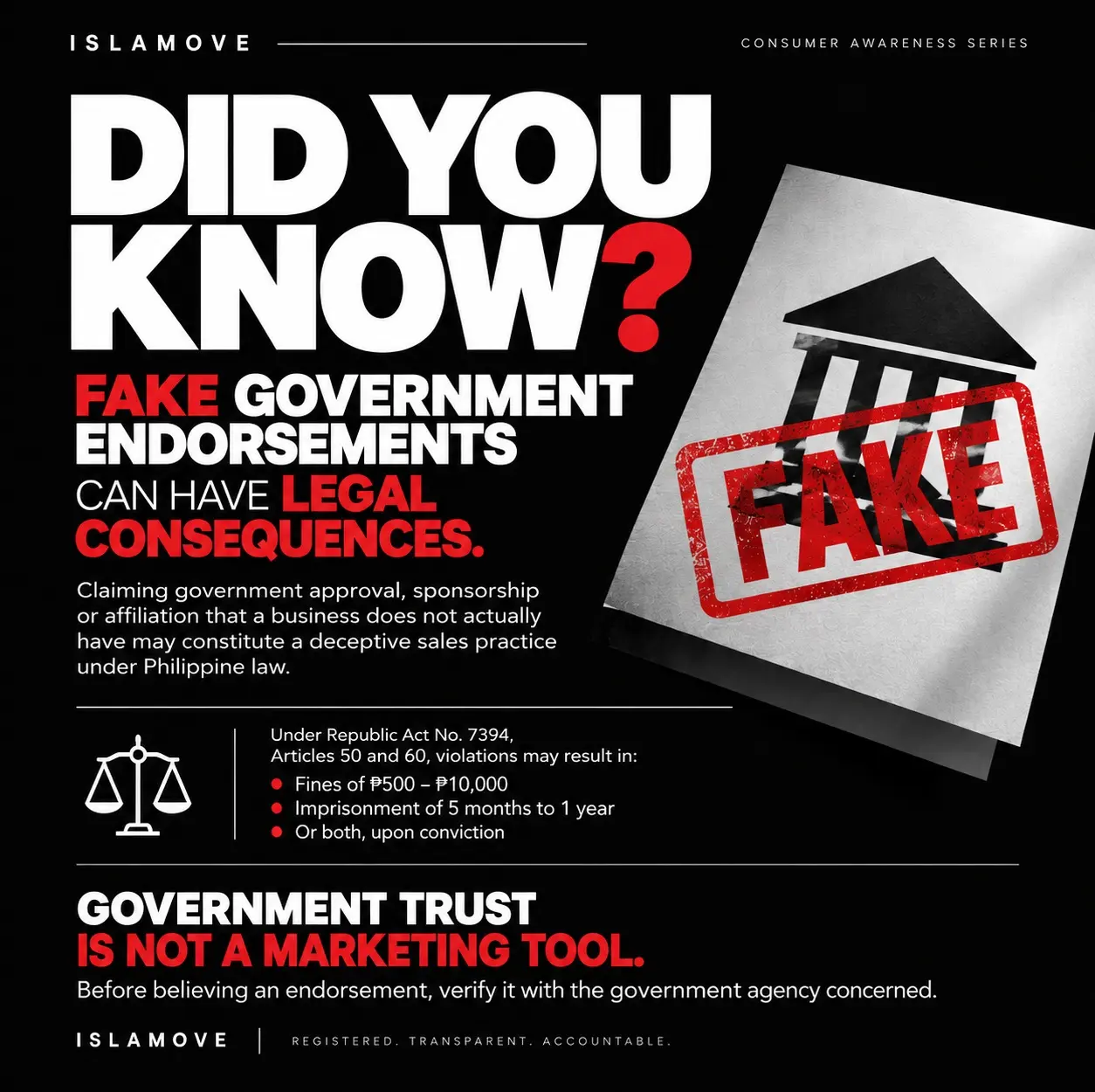
DID YOU KNOW? Falsely claiming government endorsement can have legal consequences in the Philippines.
You've probably seen businesses displaying government logos on their websites or proudly announcing that they are "DTI Endorsed," "Government Approved," or an "Official Government Partner."
Sounds impressive, right?
After all, government recognition can immediately create a sense of credibility. It suggests that a business has been evaluated, approved, or officially supported by a government agency.
But here's something every consumer should know:
Registering a business, meeting with government officials, or discussing potential partnerships does not automatically mean a business is government-endorsed.
At IslaMove, we believe the distinction matters. Because trust should be earned through legitimate operations, transparency, and accountability, not implied through government connections.
Registration Is Not Endorsement
Let's clear up one common misconception.
Registering a business name with the Department of Trade and Industry (DTI) does not mean the Philippine government endorses, recommends, or guarantees that business.
DTI business-name registration establishes the registration of a business name. It is not a government recommendation, and it does not, by itself, authorize a business to operate.
Even the Philippine E-Commerce Trustmark, an official DTI initiative intended to promote confidence in online transactions, does not constitute an endorsement of an individual business, product, or service.
So when a company advertises itself as "DTI Endorsed," there's a perfectly reasonable question to ask:
Endorsed by whom, for what purpose, and where is the proof?
A Government Meeting Is Not a Government Endorsement
Here's another distinction that deserves attention.
Businesses regularly meet with government officials to introduce their services, seek guidance, present proposals, and explore possible collaborations.
These meetings are normal, and they can be valuable for local economic development.
But a meeting is not an endorsement.
Being photographed with a government official does not establish official sponsorship. Presenting a business proposal does not mean it has been approved. And discussing a potential partnership does not mean that partnership has been formally established.
A conversation is not a certification. A meeting is not an endorsement. And a proposal is not an approved partnership.
IslaMove itself has engaged with government representatives to explore how technology could support transportation, logistics, and local businesses in Siquijor.
We welcome these discussions because we believe collaboration can create opportunities for the island.
But we also recognize the responsibility to describe those interactions accurately.
Engaging with government is not the same as being endorsed by government.
And no business should use ordinary meetings or informal discussions to imply official approval that has not actually been granted.
Why Government Credibility Matters More Than Ever
With corruption allegations and questions about government accountability continuing to draw public attention in the Philippines, transparency has become more important than ever.
Government names, official seals, and institutional endorsements carry significant weight. They represent public authority and should never be used casually to create an impression of credibility.
Government endorsement is not a marketing privilege that businesses can simply award themselves.
Official approvals, accreditations, and endorsements have different requirements depending on the government agency involved. A business should never imply that it has received official backing without a legitimate basis for that claim.
At a time when Filipinos are demanding greater transparency and accountability from public institutions, private businesses should be held to equally high standards of honesty in how they represent their government relationships.
Public trust deserves protection, not exploitation.
What Does Philippine Law Say About False Endorsements?
False claims of government sponsorship, approval, or affiliation may raise concerns under Republic Act No. 7394, also known as the Consumer Act of the Philippines.
Article 50 addresses deceptive sales practices, including false representations concerning sponsorship, approval, or affiliation in consumer transactions.
Under Article 60, violations of the relevant provisions may result in:
- Fines ranging from ₱500 to ₱10,000
- Imprisonment ranging from five months to one year
- Or both, upon conviction
These consequences are not automatic. Whether a particular claim violates the law depends on the circumstances, evidence, and applicable legal requirements.
The important point is that businesses must be careful about how they represent government relationships, especially when those representations could influence consumer decisions.
Government credibility is not a marketing shortcut.
Why This Matters for Siquijor
Siquijor is evolving.
More local businesses are adopting digital services, online ordering, electronic payments, and technology-driven solutions.
This creates exciting opportunities for entrepreneurs, restaurant owners, residents, and visitors.
But as the island's digital economy grows, so does the importance of transparency.
Imagine a tourist choosing a delivery service because its website suggests official government approval.
Or a restaurant owner entering a partnership because they believe a platform has government backing.
If that impression is based on an unsupported claim, it could influence decisions that might otherwise have been different.
This is why accurate business representations matter.
Fair competition should be built on service quality, reliability, innovation, and accountability, not on exaggerated claims of official recognition.
How IslaMove Chooses to Build Trust
At IslaMove, we believe credibility begins with how a business actually operates.
Behind the platform is ISLAMOVE SIQUIJOR DELIVERY SERVICES, a Philippine business registered with the DTI and BIR.
Our fully cashless food delivery platform supports GCash, Maya, QR Ph, Visa, Mastercard, Apple Pay, Google Pay, and international debit and credit cards.
Customers can review their delivery charges before checkout. Payments are processed digitally, and riders do not collect cash from customers.
Our restaurant partners have a structured platform for receiving orders, managing deliveries, and tracking transactions.
These are practical systems designed to support transparency and accountability.
We don't claim that having registrations, payment infrastructure, or government meetings makes us better than everyone else.
We believe our customers and restaurant partners should judge us by the service we provide and how responsibly we operate.
Because real credibility comes from what a business does, not who it claims to know.
Before Believing a Government Endorsement, Ask Three Questions
The next time you encounter a business claiming government approval, sponsorship, or affiliation, consider asking:
-
Which government agency issued the endorsement? A legitimate claim should identify the agency and the nature of its involvement.
-
Is there official documentation? A government logo, photograph, meeting invitation, or verbal statement is not necessarily proof of endorsement.
-
Can the agency independently confirm it? Contact the government office through its official communication channels to verify the claim.
Government agencies may issue different types of approvals, registrations, accreditations, and formal agreements. Each has its own meaning and limitations.
The key is to verify exactly what has been granted rather than assuming all forms of government interaction amount to endorsement.
Trust Is Earned, Not Borrowed
At IslaMove, we believe Siquijor deserves modern digital services supported by responsible business practices.
We welcome opportunities to work with local businesses, communities, and government institutions.
But we also believe that every business has a responsibility to represent those relationships truthfully.
Registration should be described as registration.
Meetings should be described as meetings.
Proposals should be described as proposals.
And endorsements should only be claimed when they genuinely exist and can be verified.
We're not asking anyone to trust IslaMove because of who we've met or which government offices we've visited.
We're asking customers and restaurant partners to judge us by our transparency, our service, and our willingness to take responsibility.
Because government trust should never be borrowed for marketing purposes.
Registration is not endorsement. A meeting is not endorsement. A photograph is not endorsement.
Trust isn't who you know. It's what you can prove.
See Something Misleading? Report It.
Consumers have the right to accurate and truthful information.
If you encounter a business claiming government endorsement, approval, or affiliation that you believe may be false or misleading, don't simply take its word for it. Verify the claim.
You can report suspected misrepresentations to the Department of Trade and Industry (DTI) or the government agency whose name or logo is being used.
Before reporting, preserve relevant evidence, such as screenshots, website links, dates, and the exact statements being made.
False claims should be questioned. Suspected violations should be reported. Accountability begins when consumers speak up.
For consumer complaints and guidance, visit the DTI official website or contact the appropriate government office.
Protect your rights. Verify before you trust. Report suspected misrepresentation.
Sources & Legal References
1. Republic Act No. 7394 - Consumer Act of the Philippines
Article 50 addresses deceptive sales practices, including false representations concerning sponsorship, approval, or affiliation. Article 60 establishes penalties for violations of the relevant provisions.
Supreme Court E-Library - Republic Act No. 7394
2. Department of Trade and Industry - Business Name Registration
DTI guidance explains that registering a business name does not, by itself, authorize a business to operate or establish government endorsement.
DTI Business Name Registration FAQs
3. Department of Trade and Industry - Philippine E-Commerce Trustmark
DTI guidance clarifies that the Trustmark does not constitute government endorsement of individual businesses, products, or services.
This article is part of IslaMove's Consumer Awareness Series. It aims to promote transparency, responsible business practices, and informed consumer decisions. It does not constitute legal advice or a legal determination concerning any specific business.
ISLAMOVE - Delivery Done Differently.
Registered. Transparent. Accountable.